

In-house training: from yesterday’s ingredient production to today’s semi-finished solutions
On Thursday 8 March 2018 at 5:30 pm, our company hosted an educational and training visit for students from the evening course of the Ettore Majorana Institute of Bari (San Paolo campus), welcomed by Dr Raffaele Nicoletti.
Located in the Jesce Industrial Area (Matera), a strategic link between Altamura and Matera, the visit focused specifically on ingredient blending based on precise formulations, designed to meet a wide range of dietary requirements: organic products, vegan options, gluten-free and lactose-free solutions, no added sugars, hypoglycaemic and low-sodium products, as well as standard product lines.
Mr Franco Laquale, the company’s Sales Manager, opened the visit by guiding us through the production area, where raw materials are packaged after being carefully weighed and accurately labelled. This process is carried out using two dedicated machines — one for small quantities and one for large volumes — both operated by experienced staff.
The packaged products, whether powder-based formulations or paste-based formulations, are sealed at two separate workstations, each clearly identified with appropriate signage.
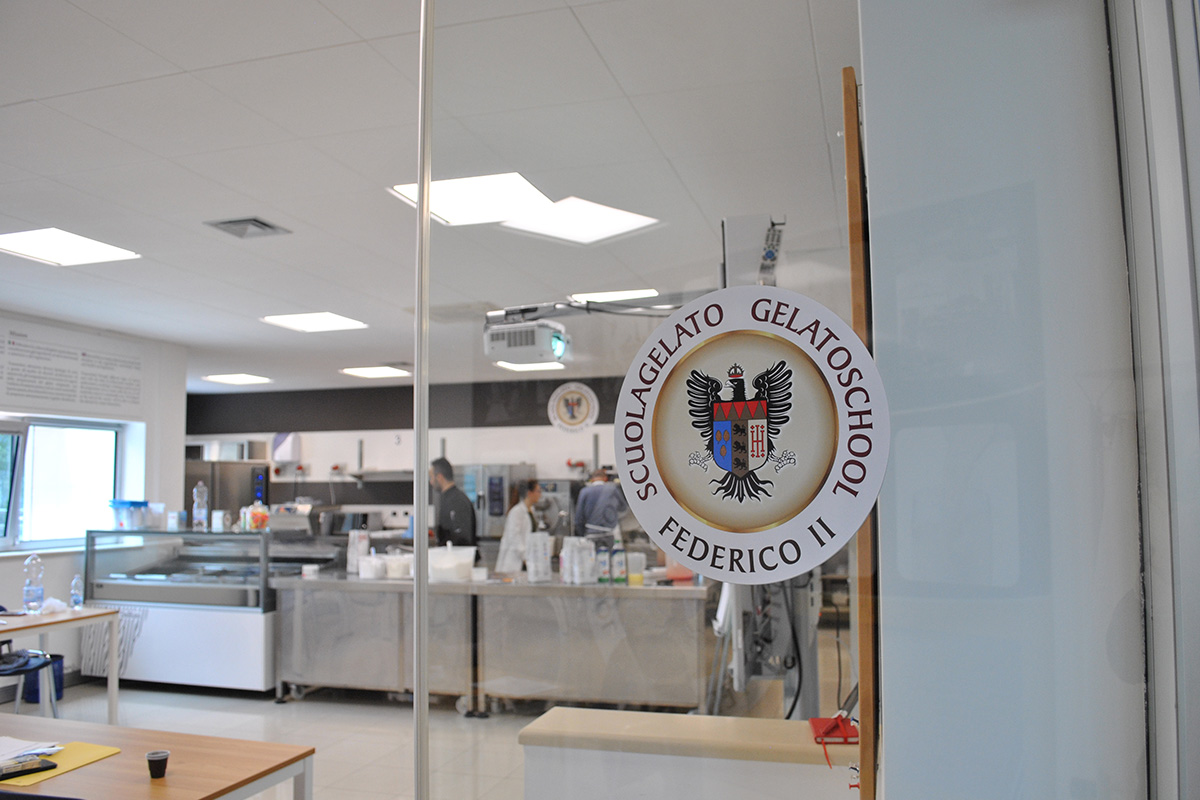
Within the company, the Federico II Artisan Gelato School is based — established to train and refine gelato makers in the production of truly “artisan” gelato. The school focuses on strengthening both theoretical knowledge and practical skills, enabling professionals to make the most effective use of the various raw materials available.
The company holds both system and product certifications, including Kosher certification for Jewish communities and Halal certification for Muslim consumers.
The visit concluded at the gelato school, where two master gelato makers demonstrated the artisan gelato production process. They also explained that around 90% of gelato shops rely on pre-mixed, ready-to-use “standard products”, as they are unable to produce gelato starting from individual raw ingredients.
This gastronomic speciality — gelato — has its origins in Asia Minor, China and Egypt. However, the product that most closely resembles modern gelato emerged in Italy during the Risorgimento period, around 1840.
Gelato is composed of three phases: a liquid phase, a solid phase and a gaseous phase. In artisan production, air is incorporated during the churning stage in the batch freezer. The level of air incorporation is known as “overrun” and can range from a minimum of around 20% in artisan gelato to a maximum of approximately 110% in industrial gelato.
To produce high-quality gelato, several key parameters must be carefully controlled, starting with proper formulation balance, known as “balancing”. In addition, production processes can involve either hot or cold methods.
The production cycle consists of five main stages, followed by storage: pasteurisation, homogenisation (not used in artisan production), ageing, churning (with the addition of flavours), and rapid cooling.
After thorough explanations, the session moved on to hands-on practice with the preparation of gelato, followed by tasting, allowing participants to fully appreciate the refinement and quality of its flavour.